Lung Cancer Research Foundation Grants Team Science Award Focused on Curing EGFR-Mutant Lung Cancers
PR Newswire
NEW YORK, April 14, 2026
Teams led by Kwok-Kin Wong, MD, PhD and Matthew Meyerson, MD, PhD receive $1.5 million grant
NEW YORK, April 14, 2026 /PRNewswire/ -- The Lung Cancer Research Foundation (LCRF) announces the first recipients of its LCRF Team Science Award on Advancing Therapies Toward Curing EGFR Mutated Lung Cancers. The project, "A novel therapeutic combination strategy to eradicate EGFR-mutant cancer persisters" was selected for this award, made possible by a generous private donation from Benay and Steven Taub.
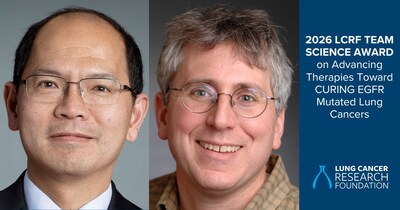
Kwok-Kin Wong, MD, PhD, will be the Principal Investigator (PI) overseeing both of the teams' projects and act as lead on Project 1. Dr. Wong is Anne Murnick Cogan and David H. Cogan Professor of Oncology at the Perlmutter Cancer Center and New York University Grossman School of Medicine. Leading Project 2 is Matthew Meyerson, MD, PhD, Professor of Genetics and Medicine at Harvard Medical School and the Charles A. Dana Chair in Human Genetics at Dana-Farber Cancer Institute. Both Dr. Wong and Dr. Meyerson are renowned figures in EGFR-mutant lung cancer research. Joining the effort are Lior Golomb, PhD in the Meyerson Lab on Project 1; with Elaine Shum, MD, Assistant Professor in the Department of Medicine at New York University Grossman School of Medicine, and Director of Cancer Screening Programs and Jiehui Deng, PhD, Research Assistant Professor in the New York University Langone Health Department of Medicine as co-investigators on Project 2. Rounding out the investigative team are Deborah Markow, lung cancer patient advocate, and Kristen Labbe, MPH, as project coordinator.
Lung cancer is the leading cause of cancer death worldwide. A common subtype, lung adenocarcinoma (LUAD), frequently carries mutations in the epidermal growth factor receptor (EGFR) gene occurring in about 10% of lung cancers in people of European or African ancestry and up to 45% in those of East Asian ancestry. Oral drugs called tyrosine kinase inhibitors (TKIs), such as osimertinib, target these mutations and have significantly improved patient outcomes, yet median survival remains only around 39 months as nearly all advanced-stage patients relapse due to drug resistance.
Resistance can arise through several mechanisms: additional EGFR mutations that block drug binding, activation of bypass signaling pathways, or cellular transformation into small-cell or squamous-cell lung cancer. However, in nearly half of relapsed patients, the cause remains unidentified, making these "hidden" resistance mechanisms one of the greatest ongoing challenges in treating EGFR-mutant lung cancer.
Dr. Wong and Dr. Meyerson's research teams have identified a gene, which when deactivated, made cancer cells more sensitive to osimertinib and prevented them from entering a state of drug resistance. Their work will be divided into two projects: Project 1 will test drug combinations in mouse models that closely replicate human lung cancer to learn about the biological and disease impacts of these combinations and how they function in the cancer cells. Project 2 will assess the tested drug combinations in the clinic and its impact on human lung cancer, with a plan to launch a phase II clinical trial in patients with high-risk EGFR-mutant non-small cell lung cancer (NSCLC).
"We aim to prevent resistance before it begins," says Dr. Wong. "Rather than allowing the cancer to form new escape routes and then trying to block them one by one, our strategy is to begin treatment with a combination therapy that can kill more cancer cells from the start, reducing the chance that any resistant cells can develop. We believe this approach can lead to deeper, more durable responses and ultimately help patients live longer."
Dr. Meyerson adds, "If we can identify a combination therapy that heads off resistance and allows better quality of life for people whose tumors harbor EGFR mutations, then we are one step closer to curing this type of lung cancer. That's incredibly exciting."
"This research project has several promising aims that could change how EGFR-mutant lung cancer is treated," remarked Antoinette Wozniak, MD, FASCO, Chief Scientific Officer for LCRF. "That the work will result in a phase II clinical trial speaks to the novel and accelerated approach the investigators are taking. Being able to deliver additional options to people before they experience treatment resistance is an important step in increasing survival."
LCRF funded early-career work by Drs. Wong and Meyerson that helped launch the field of targeted therapy in lung cancer. In the early 2000s, Dr. Meyerson's team discovered EGFR mutations in lung cancer: foundational work that shaped genome analysis, clinical trials, and today's treatments for oncogenic-driven cancers. He also received two legacy organization awards from LCRF: the 2011 Caine Halter Hope Now Award, and a 2004 award for his project titled "Novel Human Lung Cancer Gene Discovery," ultimately identifying 93 alterations and advancing multiple clinical trials. This Team Science Award unites these two renowned researchers in continued pursuit of a cure for EGFR-mutant lung cancer.
To learn more about this award and the project, visit LCRF.org/CurrentResearch.
About the Lung Cancer Research Foundation (LCRF)
The Lung Cancer Research Foundation® (LCRF) is the leading nonprofit organization focused on funding innovative, high-reward research with the potential to extend survival and improve quality of life for people with lung cancer. LCRF's mission is to improve lung cancer outcomes by funding research for the prevention, diagnosis, treatment, and cure of lung cancer. To date, LCRF has funded 450 research grants, totaling nearly $53 million, the highest amount provided by a nonprofit organization dedicated to funding lung cancer research. For more information about the LCRF grant program and funding opportunities, visit LCRF.org/research.
Contact:
LUNG CANCER RESEARCH FOUNDATION (LCRF)
Sheila Sullivan
Sr. Director, Marketing & Communications
ssullivan@lcrf.org
 View original content to download multimedia:https://www.prnewswire.com/news-releases/lung-cancer-research-foundation-grants-team-science-award-focused-on-curing-egfr-mutant-lung-cancers-302740846.html
SOURCE Lung Cancer Research Foundation