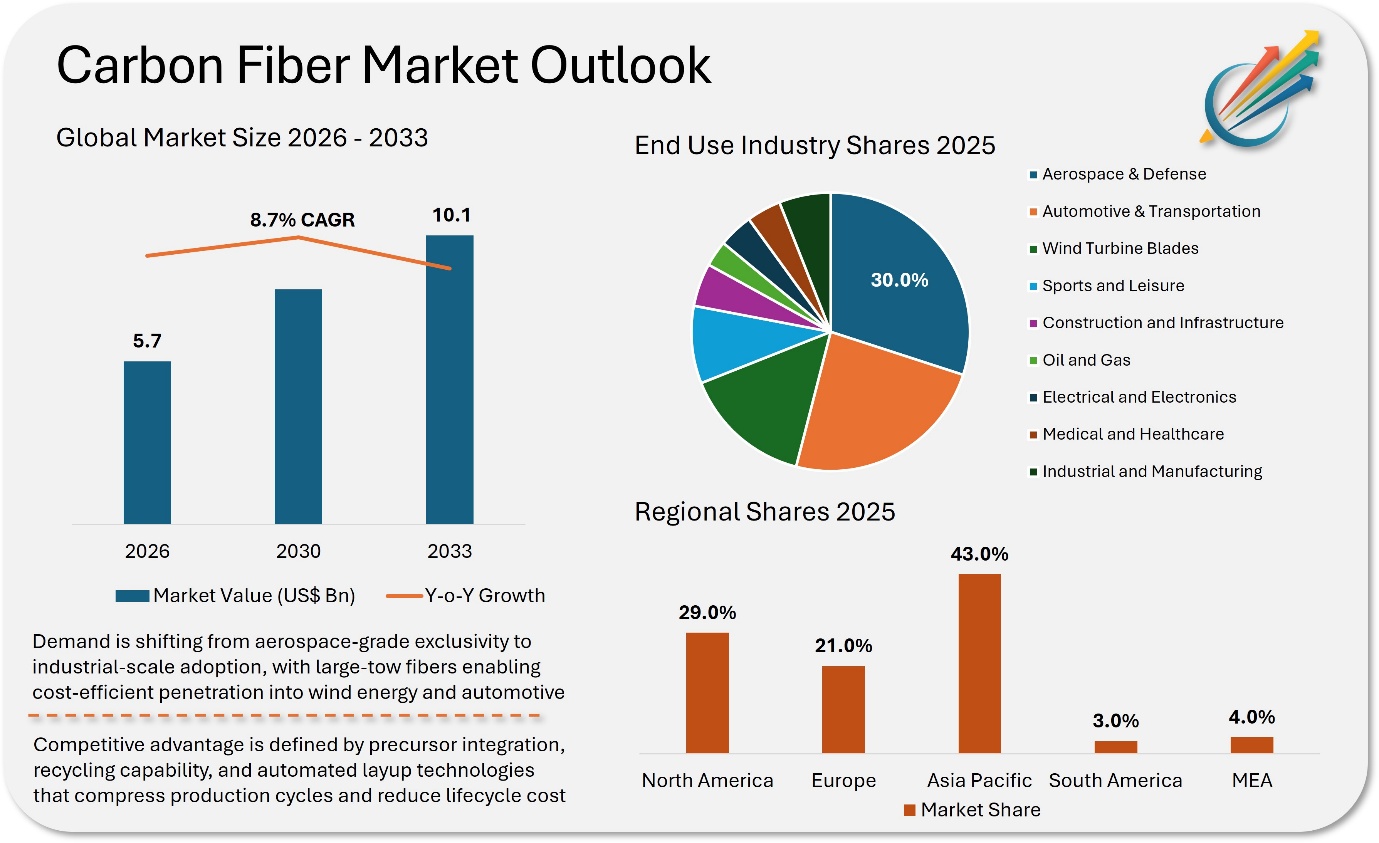
New York, NY, Feb. 24, 2026 (GLOBE NEWSWIRE) -- The carbon fiber market is poised to expand from USD 5.7 billion in 2026 to USD 10.1 billion by 2033, with an annualised growth rate of 8.7% during 2026 and 2033. Demand for carbon fiber is increasing owing to accelerating demand for lightweight, high-strength materials across aerospace, automotive, wind energy and industrial applications. Carbon fiber composites offer superior tensile strength, corrosion resistance and fatigue performance compared to its traditional counterparts. As aerospace sector witnessing a substantial growth, the strategic focus has shifted toward reducing the energy intensity of the carbonization process and diversifying precursor sources to hedge against volatile acrylonitrile prices.
Industry transformation is being focused on global decarbonization targets, fuel efficiency standards and renewable energy expansion. Regulatory shifts, such as the EU’s Carbon Border Adjustment Mechanism are forcing producers to innovate in recycling technologies. This pivot ensures that carbon fiber remains a viable material for high-volume applications like wind turbine blades and electric vehicle chassis. Aerospace production recovery and next-generation aircraft programs are reinforcing long-term demand in carbon fiber market. Further, EV manufacturers are incorporating carbon fiber components to offset battery weight. Technological advancements in precursor materials and automated fiber placement are gradually reducing production costs.
Request a Sample Report to Explore Key Market Insight: https://marketmindsadvisory.com/request-sample/?report_id=32187
Key Takeaways from Carbon Fiber Market
- Carbon fiber market size is expected to reach USD 10.1 billion by 2033, growing at a robust 8.7% CAGR.
- The aerospace & defense segment remains the largest revenue contributor due to high-margin, high-modulus fiber requirements.
- Pressure vessels for hydrogen storage is projected to be the fastest-growing application during the forecast period.
- PAN-based carbon fiber remains a prominent revenue contributor.
- China and South Korea are emerging as key investment hotspots due to massive domestic subsidies for EV and hydrogen infrastructure.
- Competition is increasing as vertical integration becomes standard, with fiber producers acquiring composite fabricators to offer finished parts.
- The development of small tow high-tensile fibers for medical and sporting goods is creating high-margin specialized value pools.
Market Dynamics Shaping the Carbon Fiber Market
Energy transition and lightweight mobility bolstering carbon fiber market
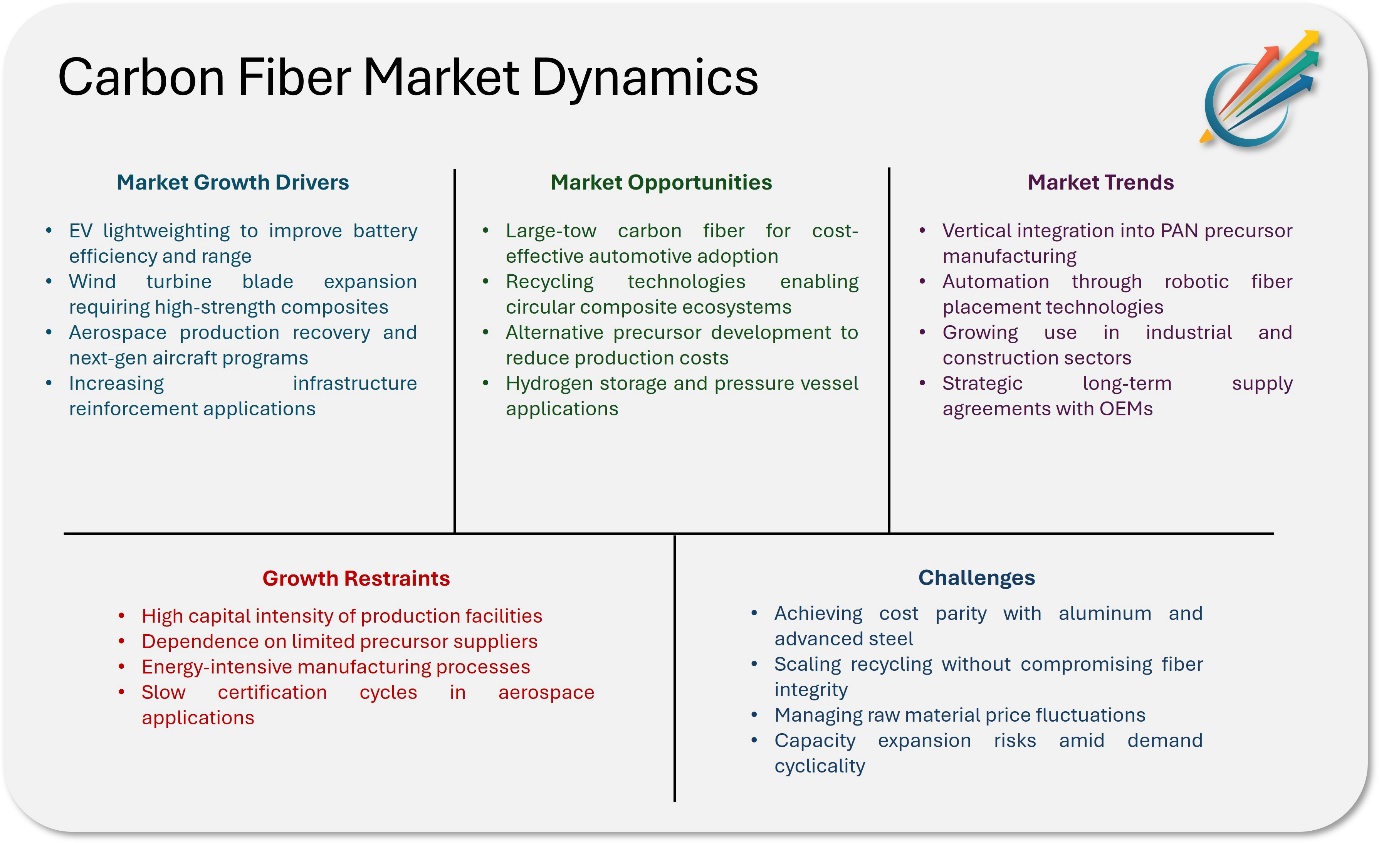
Global decarbonization policies are accelerating demand for lightweight materials that enhance fuel efficiency and energy output. In wind turbines, longer blades made from carbon fiber improve energy capture and structural stability. In automotive and EV manufacturing, carbon fiber reduces vehicle weight, extending battery range and lowering emissions. Aerospace manufacturers continue to integrate high-performance composites to enhance durability and reduce operating costs. As regulatory pressure on emissions intensifies, carbon fiber’s strength-to-weight ratio positions it as a strategic material in achieving sustainability targets across transport and renewable energy sectors and is fostering the carbon fiber market.
Need tailored insights? Request for a customization report: https://marketmindsadvisory.com/request-customization/?report_id=32187
Cost reduction through advanced manufacturing creating lucrative opportunities for the carbon fiber market
Emerging technologies such as, automated fiber placement, resin transfer molding, as well as alternative precursor development are improving production scalability. Manufacturers are investing in large-tow carbon fiber to reduce per-unit cost for industrial and automotive applications. Recycling technologies are also gaining traction, creating secondary supply streams and sustainability benefits in the carbon fiber market. As production efficiencies improve, carbon fiber adoption is expected to expand into mid-volume automotive and infrastructure applications creating ample opportunities for the key market participants over the coming forecast period.
High energy intensity and supply chain concentration impacting carbon fiber market growth
Dependence on polyacrylonitrile precursors exposes the market to raw material price volatility and it is also a energy-intensive carbonization process. Limited global production capacity and geographic concentration of key suppliers create supply risks. Additionally, processing complexity and certification requirements in aerospace slow new supplier entry in which specialized nature of the equipment means that adding new capacity takes years. These cost and supply constraints limit adoption in price-sensitive industries, posing a structural barrier to widespread commoditization in carbon fiber market.
Carbon Fiber Market Segmentation
By Product Type
- Carbon Fiber Tow
- Carbon Fiber Fabric
- Carbon Fiber Prepreg
- Carbon Fiber Yarn
- Chopped Carbon Fiber
- Milled Carbon Fiber
- Carbon Fiber Mats
Carbon fiber tow consisting of continuous and untwisted filament bundles, remains core product segment in carbon fiber market as it functions as the primary feedstock for downstream processes such as filament winding, pultrusion, and automated fiber placement especially in aerospace-grade applications. Chopped and milled carbon fibers are emerging as high-growth formats, supported by rising adoption of recycled carbon fiber streams. Manufacturers are leveraging these shorter fiber forms to reduce material costs and expand penetration into semi-structural applications, including automotive under-hood components and consumer electronics casings, where performance-to-cost optimization is critical.
By Fiber Type
- Virgin Carbon Fiber
- Recycled Carbon Fiber
Virgin carbon fiber continues to command over 90% of carbon fiber market share, owing to aerospace, structural automotive, and wind energy applications demand consistent mechanical strength, stiffness, and reliability. Recycled carbon fiber is gaining measurable momentum as manufacturers recognize the untapped value in production scrap and end-of-life composites. While recycled variants typically exhibit 20–30% lower mechanical performance, they are increasingly specified for semi-structural and aesthetic applications where cost efficiency and sustainability credentials take precedence.
By Raw Material
- Polyacrylonitrile (PAN)
- Pitch
- Rayon
- Lignin
- Polyethylene
- Others
Raw material availability and price stability significantly influence market competitiveness and investment planning. PAN-based carbon fiber holds a prominent share in carbon fiber market due to consistent mechanical properties and established manufacturing processes. Pitch-based fibers are used in high-modulus and thermal management applications, particularly in aerospace and electronics. PAN’s versatility supports diverse end uses, while pitch fibers cater to specialized requirements. Innovation in precursor chemistry continues to refine performance-to-cost ratios. Rayon-based carbon fiber has limited commercial presence due to cost and performance constraints.
By Tow Size
- 1K–6K
- 12K–24K
- 48K–60K
- Above 60K
Tow size selection directly affects production economics and end-product performance in carbon fiber market. Small tow fibers (1k-6k) are preferred in aerospace for high-performance laminates and superior finish quality. Large tow fibers are projected to grow faster due to cost advantages in wind energy and automotive applications. Manufacturers are expanding large tow capacity to address volume-driven industries.
By Application
- Composites Reinforcement
- Structural Components
- Pressure Vessels
- Tooling and Molds
- Electrical and Electronic Components
- Thermal Management Components
- Filtration and Separation Media
- Others
Composites reinforcement is a key application segment, where carbon fiber is integrated into polymer, metal, or ceramic matrices to produce lightweight, high-strength structural systems. This foundational use spans aircraft fuselages, automotive body panels, and wind turbine spars. Demand for structural components continues to rise as carbon fiber outperforms aluminum and fiberglass in strength-to-weight ratio, fatigue resistance, and corrosion durability. Hydrogen storage tanks for fuel cell vehicles and industrial gas transport are emerging as high-growth niches, reinforcing carbon fiber’s role in next-generation energy infrastructure.
By End Use Industry
- Aerospace & Defense
- Commercial Aircraft
- Military Aircraft
- Spacecraft and Launch Vehicles
- Unmanned Aerial Vehicles
- Automotive & Transportation
- Passenger Vehicles
- Commercial Vehicles
- Marine
- Others
- Wind Turbine Blades
- Sports and Leisure
- Construction and Infrastructure
- Oil and Gas
- Electrical and Electronics
- Medical and Healthcare
- Industrial and Manufacturing
Aerospace & defense continues to lead in revenue generation due to strict performance requirements and supported by commercial aircraft production recovery. The energy sector, especially wind power, is witnessing rapid expansion driven by demand for longer, lighter turbine blades. Automotive adoption is rising steadily with EV lightweighting strategies where manufacturers are integrating carbon fiber into structural and semi-structural components. Industrial uses span pressure vessels, pipes, and advanced equipment. Sporting goods and construction applications contribute niche but stable demand in carbon fiber market.
By Region
- North America
- Europe
- Asia Pacific
- South America
- MEA
Asia-Pacific leads in the carbon fiber market in both production and consumption, with China expanding in several end use sectors and Japan strengthening aerospace component manufacturing. Japan remains a technological hub focusing on ultra-high-modulus fibers that define the next generation of space exploration and high-speed rail. North America remains a strong market, driven by U.S. aerospace and defense programs. Europe, especially Germany is investing in automotive lightweighting and renewable energy infrastructure.
Purchase the Full Market Report with In-Depth Analysis & Forecasts: https://marketmindsadvisory.com/buy-now/?report_id=32187
Competitive Landscape – Carbon Fiber Market
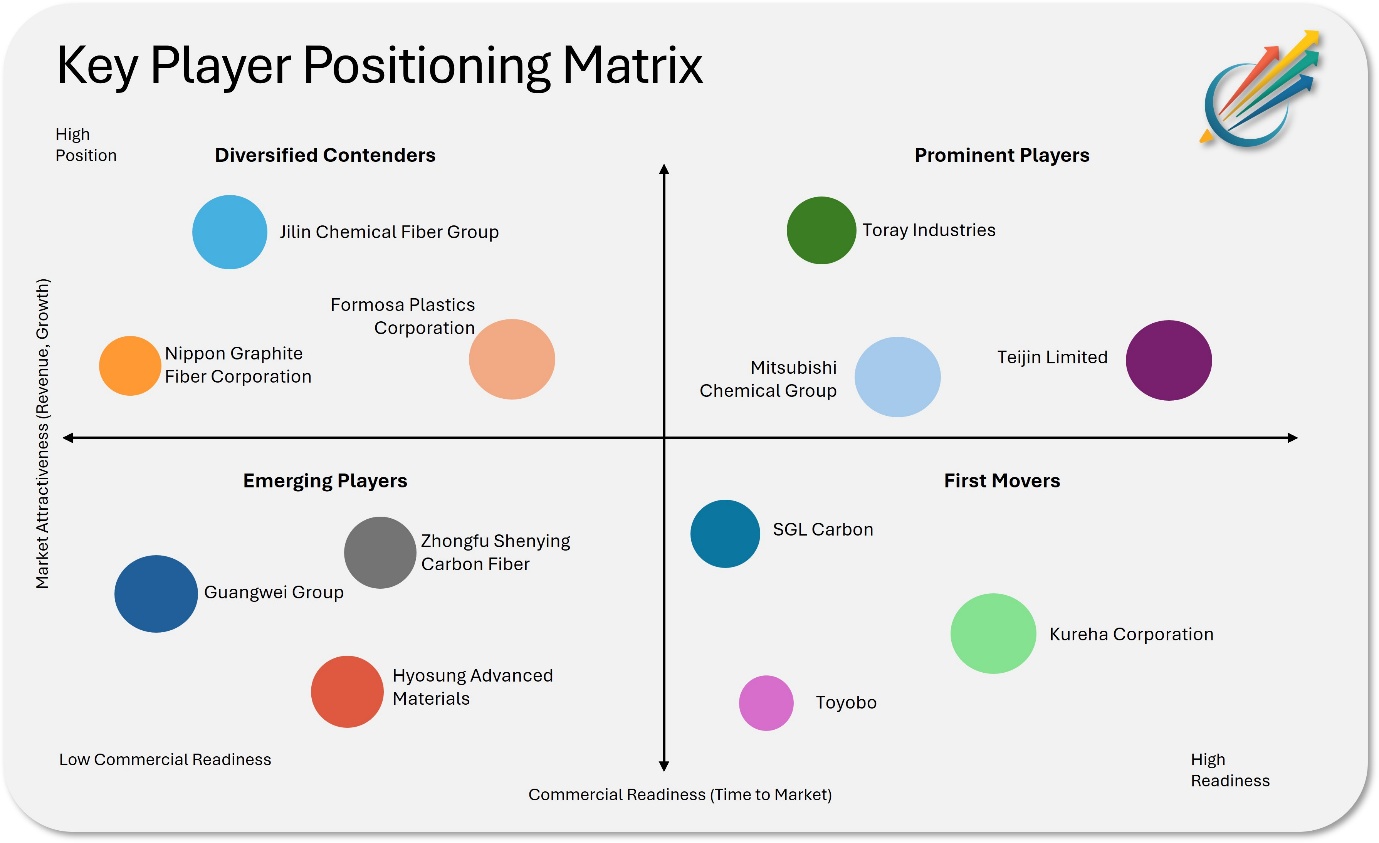
Leading players in carbon fiber market are focusing on capacity expansion, precursor integration, and strategic partnerships with aerospace and wind OEMs. Vertical integration into PAN production is becoming a key strategy to control costs and secure supply. Key players are also entering into long-term strategic alliances with hydrogen tank manufacturers to ensure guaranteed offtake as the market for fuel cells matures. Companies are further investing in recycling technologies and large-tow production lines to penetrate automotive markets.
Key Players in Carbon Fiber Market are
- Toray Industries
- Teijin Limited
- Mitsubishi Chemical Group
- Hexcel Corporation
- SGL Carbon
- Solvay
- Formosa Plastics Corporation
- Aksa Karbon ve İleri
- Hyosung Advanced Materials
- Zhongfu Shenying Carbon Fiber
- Jilin Chemical Fiber Group
- Guangwei Group)
- Jiangsu Hengshen Co., Ltd.
- Nippon Graphite Fiber Corporation
- Toyobo
- Kureha Corporation
- Syensqo
- Osaka Gas Chemicals
- Umatex Group
- Vartega Inc.
- Flink International Co., Ltd
Key Developments:
- In October 2025, Toray Industries unveiled a proprietary thermal degradation recycling process that recovers carbon fiber with 95% tensile strength retention, integrating it into a partnership with a major Japanese auto OEM.
- In 2025, Teijin introduced Tenax Next sustainable carbon fiber series at JEC World, offering a 35%–36% CO2 reduction compared to conventional fibers.
- In 2024, Hexcel Corporation expanded its Alabama facility to support the surge in demand from the US defense sector, specifically for drone and missile fuselage programs.
- In July 2025, Hexcel Corporation launched high-temperature carbon fiber prepregs for aerospace engines and industrial use.
- In December 2023, Solvay spun off its composite materials business to focus purely on high-performance specialty polymers, creating agile dedicated competitor in the aerospace composites space.
Browse the Complete Research Report: https://marketmindsadvisory.com/carbon-fiber-market/
Trending Related Reports
The basalt fibre market is set for robust growth, projected to reach USD 276.2 million in 2024 and expand at an impressive CAGR of 12.6% during the forecast period.
The global polyimide fibers market is expected to grow steadily, reaching a valuation of USD 518.5 million in 2024 and projected to expand to USD 570.5 million by 2034.
The global aramid fiber market is anticipated to achieve significant growth, with its valuation estimated at USD 5 billion in 2024 and projected to reach USD 7.8 billion by 2034, growing at a CAGR of 6.5% during the forecast period.
The glass fiber reinforced plastic composites market is set to grow substantially, with its valuation projected to rise from USD 19.54 billion in 2025 to USD 42.53 billion by 2035, expanding at a CAGR of 9.4% during the forecast period.
The global wind turbine blade repair material market is set to grow significantly, increasing from USD 627.6 million in 2025 to USD 2.94 billion by 2035, reflecting an impressive 13.0% CAGR.
The global prepreg composite fibers market is poised to expand from USD 9.2 billion in 2025 to an impressive USD 24.4 billion by 2035, registering a robust CAGR of 12% over the forecast period.
The global Recycled Carbon Fiber Market is projected to witness substantial growth, reaching an estimated valuation of USD 56.9 million in 2025, with a robust CAGR of 13.3% through 2035.
The global advanced polymer composites market was valued at USD 12.12 billion in 2025 and is anticipated to reach a valuation of USD 20.73 billion by 2035, progressing at a CAGR of 6.9% during the forecast period.
The global advanced automotive materials market is anticipated to experience robust growth, projected to expand at a CAGR of 7.8% during the forecast period from 2025 to 2035.
The global aerospace lightweight materials market is set for significant expansion, with an estimated value of USD 40 billion in 2025 and projected to reach approximately USD 78.29 billion by 2035, growing at a robust CAGR of 8.08% during the forecast period.
Why choose Market Minds Advisory
Market Minds Advisory delivers decision-grade intelligence trusted by executives across machinery & equipment, packaging, chemical, automotive, information & communication technology, food & beverage, consumer goods, healthcare and other industries. We provide market expansion strategies, go-to-market strategies, market share acceleration, brand positioning analysis, and account enablement and growth. Our forecasting methodology integrates primary interviews, proprietary demand models and continuous market validation to ensure accuracy in volatile and emerging industries. With over 10 years of industry experience and insights derived from primary interviews with several industry stakeholders, our research provides actionable insights and white space analysis for the emerging segments providing the opportunity gaps in the market accounting recent market developments and geopolitical risks. We believe in unlocking growth by helping businesses to see the future of their markets.
Contact Us
Market Minds Advisory

86 Great Portland Street, Mayfair, London,

W1W 7FG, England, United Kingdom

T: +44 020 3807 7725

Email: sales@marketmindsadvisory.com
Website: https://marketmindsadvisory.com/
LinkedIn | Facebook | Twitter | Instagram
Attachments

Market Minds Advisory 86 Great Portland Street, Mayfair, London, W1W 7FG, England, United Kingdom T: +44 020 3807 7725 Email: sales@marketmindsadvisory.com